Motivation
Chapter 1 introduced positive-base exponentials, inverse logarithms and a decay model. This chapter develops the underlying algebra beyond that introductory model. You should be able to distinguish integer, rational and real powers; state safe hypotheses for power and logarithm laws; solve elementary exponential and logarithmic equations and inequalities; and turn a repeated-factor error requirement into an integer threshold.
The main discipline is to keep the number system and domain visible. A law valid for positive bases and arbitrary real exponents need not remain valid for negative bases. A logarithmic simplification must not create a logarithm of a nonpositive number.
9.1 Integer powers and the zero cases
For a positive integer , define as repeated factors of a real number . For , set and . Integer exponent laws follow by grouping and cancelling factors:
For a nonzero real these hold for all integer . Also, for real and integer , and . Nonzero assumptions can be weakened when all exponents are positive, but they must be restored whenever a negative exponent or a quotient requires them.
For zero, when is a positive integer. Negative powers of zero are undefined, because they require division by zero. We leave the expression undefined in this chapter. A polynomial's constant term is a prescribed constant; writing it as the zeroth term in a finite geometric sum does not require a general assignment to the indeterminate expression .
Worked example 9.1.1
Worked example 1: organize before evaluating. Since the base two is nonzero,
For a signed base, parentheses matter: , while . The minus sign in the latter expression is not part of the exponentiated base.
9.2 Rational and real powers: when positivity matters
For and integers with , define as the unique positive th root of . The definition agrees for equivalent fractions. In particular is positive, even when is even: the notation denotes the nonnegative-root function, not both solutions of an equation.
For a negative base, a real th root exists when is odd. In this elementary setting, interpret a rational exponent in lowest terms with : if is odd, define ; if is even, the expression is not a real number. This convention does not extend a negative base to arbitrary irrational powers as a real-valued function.
Worked example 9.1.2
Worked example 2: roots and solution sets. We have , not . The equation has two solutions, . Also
But is not a real number. Chapter 8 can solve the corresponding complex root equation; it does not justify treating every real-exponent law for negative bases as valid.
Proposition 9.1.3
For a positive real base , the real power is defined for every real exponent . We use the usual real exponential extension, consistent with rational powers, and the laws
The construction immediately below proves these laws, continuity, strict monotonicity for , and the positive range. It constructs exponentiation before defining inverse logarithms; the formula is then a consequence, not a circular premise.
Foundation: positive real powers without logarithmic circularity
Standing assumptions. We take the real numbers as a complete ordered field and use induction on nonnegative integers. Finite algebra, absolute value and the definition of a sequence limit are the basic language. No logarithm, real exponential, derivative, integral or complex power law is assumed in this construction. Negative-base irrational powers are not being defined. The usual constant may be chosen as a base after the construction; no differential characterization of is needed for the algebra here.
1. Integer bounds, rational approximation and positive roots. The positive integers are unbounded: if their supremum were , some integer would exceed , and its successor would exceed . Thus the Archimedean property holds. For every real an integer floor exists, since sufficiently large positive and negative integers bound and the finite intervening integer list has a largest member not exceeding . Consequently satisfies . Between distinct reals , choose with ; then lies strictly between them. These facts use completeness and integer order, not exponentials.
Existence of positive real roots. In the complete ordered real field, for and integer , let . It contains and is bounded above by , so exists. Finite factorization gives, for nonnegative ,
Take . If , choose so ; then , contradicting the upper bound . If , choose with . Then , and monotonicity of integer powers on nonnegative numbers makes an upper bound of , contradicting its supremum. Hence . At the unique nonnegative root is zero. The same factorization shows whenever , so this positive root is unique.
2. Rational powers and their laws. For , define by the positive th root of , where , and negative integer powers use reciprocals. If , raising the two positive candidate values to gives the same value ; uniqueness of a positive root proves independence of the fraction. To add rational exponents, put them over a common positive denominator and write all powers as integer powers of its unique positive root. The integer grouping laws then give and for rational . Positive-root uniqueness applied to integer products likewise gives for and rational : if , the positive number has th power and is therefore the defining positive root.
For , a positive rational power is greater than one, so is strictly increasing in rational . Induction proves Bernoulli's inequality for : multiplication by adds the nonnegative term to the next step. With it yields
Thus , and for rational , .
3. Supremum extension and the addition law. For and real , define
Choose integers . Then belongs to the set and is an upper bound. The supremum therefore exists and is at least ; this does not assert a positive lower bound for every member of the defining set. For rational it equals the rational power . With and , monotonicity on rational exponents gives
An integer bounds , so . Hence . For real , put . Then , and
The rational addition law gives , and the factors are bounded above by one fixed integer power. Since , the displayed bound proves . The elementary product-limit step is justified directly by
because a convergent satisfies on a tail. Choose and on a common tail; the right side is then smaller than . The squeeze steps follow by making their explicit nonnegative upper bounds smaller than .
The defining sets show that is nondecreasing, , and the addition law gives . If , choose a rational ; then . Therefore implies : the extension is strictly increasing.
4. Continuity and every positive output. If , then
Both bounds approach one; for , . Given any tolerance, choose so the bounds differ from one by less than that tolerance, then take . This proves continuity at zero. The addition law proves continuity at every , with the tolerance divided by the fixed positive factor .
Bernoulli gives , which is unbounded; . Fix . The real set is therefore nonempty and bounded above. Let . If , continuity gives a small with , contradicting the upper bound . If , continuity gives a small with ; monotonicity then makes an upper bound of , contradicting the least upper bound. Thus . Strict monotonicity makes this preimage unique. We have constructed a continuous bijection without logarithms.
5. All positive bases and the remaining real-exponent laws. Set . For define ; for write . These definitions agree with rational powers, preserve the addition law and continuity, and give strict decrease and the same positive range when .
For , choose rationals . Continuity in the exponent and the rational law give . For the power-of-a-power law, first let be rational with . The addition law proves , so positive-root uniqueness gives . Integer powers and reciprocals now give . Finally take rationals and use continuity of both exponent functions in to obtain . Every base used in these root and continuity steps is positive.
6. Inverse logarithms, with no cycle. For , , define to be the inverse of the bijection just proved. A strictly increasing function has a strictly increasing inverse; a strictly decreasing one has a strictly decreasing inverse, since the two possible input orders give the corresponding strict output orders. This proves the monotonicity used in logarithmic inequalities. The product, quotient, power and change-of-base logarithm proofs in this chapter now rest on the independently constructed exponent laws and inverse identities. If and , then and the now proved power law gives as a consequence, not a circular definition used to justify those same laws.
Common mistake
Do not transplant the middle law to an arbitrary negative base. With , , , the expressions are both real, but
Thus even having defined individual expressions does not make the unrestricted law true. Similarly for real , not in general.
9.3 Logarithms and their laws with proofs
Definition 9.1.4
For , , the function maps bijectively onto . Its inverse is . Therefore
The base must be positive and not one, and the argument must be positive. In particular, and . There is no real ; the fact that positive arguments may approach zero is not an assignment of a real logarithm at zero.
Proposition 9.1.5
For positive and real ,
Proof
To prove the product law, write , . Then , , so . Applying the inverse gives the result. The quotient proof uses . The power proof uses , permitted because the base is positive. These are consequences of exponent laws and invertibility, not independent symbolic tricks.
Concept lensStructural
Logarithms translate multiplication into addition
Together, the laws say that matches the positive reals one-to-one with all reals, turning products into sums, quotients into differences and powers into multiples. A multiplicative question about positive numbers thus becomes an additive question about their logarithms.
Worked example 9.1.6
Worked example 3: a safe expansion. If and ,
If and , the original argument is still positive, but the written term is undefined. A valid formula for all , is instead
An expansion may require more restrictions than the original expression if absolute values or case distinctions are omitted.
There is no logarithm law turning a sum into a sum of logarithms. For example, , while . The product law applies to multiplication, not to addition.
For another permitted base , , change of base gives
To prove it, set , so . Taking gives . The denominator is nonzero because . Choosing gives .
9.4 Monotonicity governs inequalities
If , and are strictly increasing. If , both are strictly decreasing. The second case can be seen from , where , and then from inversion.
Consequently, for positive ,
The reversal is essential. The argument positivity conditions remain in force even when the logarithm disappears from the final inequality.
Worked example 9.1.7
Worked example 4: a logarithm with base below one. Solve
First, . Because the logarithm is decreasing, comparison with gives . Combining with the domain yields
At equality holds; at the logarithm is undefined. Forgetting the base reversal would select the wrong side of the endpoint.
A logarithm is positive when its argument is above one for bases greater than one; for bases below one the positive-logarithm arguments lie between zero and one. A negative logarithm is an ordinary real output, not an indication that its argument was negative.
9.5 Solving equations without inventing solutions
Worked example 9.1.8
Worked example 5: a logarithmic equation. Solve
Both arguments must be positive, so . On that domain the product law and invertibility give
Only lies in the original domain. Substitution gives . The other algebraic root is not a solution of the original equation. A positive product alone would not guarantee that its two factors were individually positive.
Worked example 9.1.9
Worked example 6: use a positive substitution. Solve for real . Let . Then , so
Both roots are positive. The equations and give and . Each checks. If the quadratic had produced a nonpositive , it would have to be rejected before taking its logarithm.
Worked example 9.1.10
Worked example 7: a variable base. Solve . Before any conversion, the base conditions are and . The inverse relation gives , with candidates and . Only three is a valid logarithmic base. Hence the unique solution is .
The notation has two mathematically different inputs: the base and the argument. If either contains a variable, its restrictions need to be recorded. In a scientific formula, unknown signs cannot be decided by what looks convenient for a logarithm.
9.6 Integer thresholds in geometric error estimates
Suppose , and an error after integer is . For a tolerance , taking natural logarithms gives
because . Thus the smallest allowed integer is
The ceiling is the least integer at least . For a strict error requirement , the inequality for is strict, so the formula becomes
Here is the greatest integer at most . These formulas include a tolerance already met at . If the application permits only , replace the outside zero by one. If , every error is zero and logarithmic division by should not be attempted; handle that case directly.
Worked example 9.1.11
Worked example 8: compare the neighboring integers. Let and require . The logarithmic threshold is approximately , so the candidate integer is . Check the exact neighboring powers rather than trusting a rounded threshold:
Because the errors decrease with , this proves the smallest permitted integer is . When a calculated threshold is close to an integer, rounding prematurely could give the wrong choice.
9.7 Power laws and dimensionless logarithmic scales
A positive-input power law may be written in dimensionally clear form as
Taking logarithms gives
The arguments are dimensionless ratios, so the equation is independent of the measurement units. On axes recording these logarithmic ratios, the model is a straight line through the origin with slope . A data pattern that is approximately straight on such axes is evidence for a candidate power law, not proof of an exact physical law beyond the observed range.
Worked example 9.1.12
Worked example 9: recover an exponent from a ratio. In a model, doubling triples . Then , so
The exponent is not three: a power-law exponent records the logarithmic ratio of changes. Once this idealized exponent is chosen, multiplying by four multiplies by .
A logarithmic score can instead be defined by for positive . Increasing by ten multiplies by ten; increasing it by three multiplies the ratio by , not by three. This statement follows from the definition without assuming a particular physical application. A logarithmic display compresses multiplicative ranges but does not turn additive changes in the original quantity into equal steps.
9.8 Graded exercises
Foundation
Quick check
(Exercise 1)
- Evaluate , , , and as real numbers.
Quick check
(Exercise 2)
- List which of , , and are defined as real numbers under this chapter's conventions.
Quick check
(Exercise 3)
- Evaluate , and .
Quick check
(Exercise 4)
- Give a checked counterexample to , using one valid base and positive arguments.
Core
Quick check
(Exercise 5)
- State the real domain of and compare it with the domain of . Where is their equality valid?
Quick check
(Exercise 6)
- Solve over the reals.
Quick check
(Exercise 7)
- Solve over the reals.
Quick check
(Exercise 8)
- Solve .
Quick check
(Exercise 9)
- Solve .
Quick check
(Exercise 10)
- Solve , stating the base restrictions first.
Quick check
(Exercise 11)
- Prove for every real . Explain why is not an equivalent real expression on the entire domain.
Quick check
(Exercise 12)
- An error is for integers . Find the smallest for (a) and (b) .
Synthesis
Quick check
(Exercise 13)
- In a positive-input power-law model, tripling multiplies by five. Find the exponent and the multiplier for multiplying by nine. State the positivity needed for taking logarithms.
Quick check
(Exercise 14)
- For the defined score , find at , and find the multiplicative change in when rises from to with fixed .
Quick check
(Exercise 15)
- A student claims by the power-of-a-power law. Evaluate each side and identify the missing hypothesis.
Quick check
(Exercise 16)
- Suppose , and is a nonnegative integer. Derive the least satisfying . Then derive the least satisfying . Compare with the ceiling and floor formulas rather than assuming the two tolerances behave the same.
9.9 Full solutions
Solution · Exercise 1
- The values are , , , , and .
Solution · Exercise 2
- The first is undefined because it requires division by zero. The second is defined and equals zero. The third has no real value because a real square cannot be negative. The fourth is defined and equals .
Solution · Exercise 3
- They are three, minus three and zero respectively: , , and .
Solution · Exercise 4
- Use base two and . The left side is , while the proposed right side is . All logarithms in this counterexample are defined.
Solution · Exercise 5
- For the first expression, require and . A sign chart gives or . The expanded expression requires and , hence only . The quotient law proves equality there. For , the original positive ratio has a real logarithm but the individual logarithms are undefined, so the expansion cannot represent it. An alternative expression on the full original domain is .
Solution · Exercise 6
- The domain requires . Combine logarithms to get , or . The candidate is inadmissible; gives . Thus two is the only solution.
Solution · Exercise 7
- Set , giving . Both roots are positive. Thus or , and each satisfies the original equation.
Solution · Exercise 8
- The domain is . The base three is greater than one, so the inequality is equivalent to . Therefore .
Solution · Exercise 9
- Require , so . Because the base is below one, comparison with gives , or . Combine to obtain , with both endpoints excluded.
Solution · Exercise 10
- Require , . The equation gives . Its real candidates are two and minus two, of which only two is a permitted base. Hence .
Solution · Exercise 11
- Since , and . The positive-argument power law gives . For negative , is undefined, whereas the original expression is defined; for example gives .
Solution · Exercise 12
- The condition is , so the least integer is six. For strict inequality require , so the least integer is seven. At six the error is exactly , which explains the difference.
Solution · Exercise 13
- With positive input and output reference ratios, , hence . Multiplying by nine multiplies by . Positive ratios ensure the real logarithms are defined; the reference ratio of input is three, not one, so the denominator logarithm is nonzero.
Solution · Exercise 14
- Rearranging gives . At , the ratio is . The score increase is fifteen, so the multiplier is . A negative score corresponds to a positive ratio below one, not a negative quantity.
Solution · Exercise 15
- The left side is , while the right is . The real-exponent power-of-a-power law was stated for positive bases; the original base is negative. Each expression having an individual real meaning is not sufficient to extend the law.
Solution · Exercise 16
- Divide by . For , already gives equality, so the least is zero. For , zero fails and one works because , so the least is one. In the general formulas makes the logarithmic threshold zero. The non-strict formula gives , and the strict formula gives , as required.
Graphical workshop G4
Quick check
(Graphical problem G4)
Straight on which axes?
A calibration exercise constructs the following exact positive dimensionless ratios. They are illustrative exercise data, not external experimental measurements. Let and , where and each numerator has the same physical units as its own reference denominator.
| Input ratio | |||||
|---|---|---|---|---|---|
| Output ratio |
The left plot shows ordinary ratio coordinates. The right plot shows the coordinates and . The candidate curves are shown only over the data's input interval .
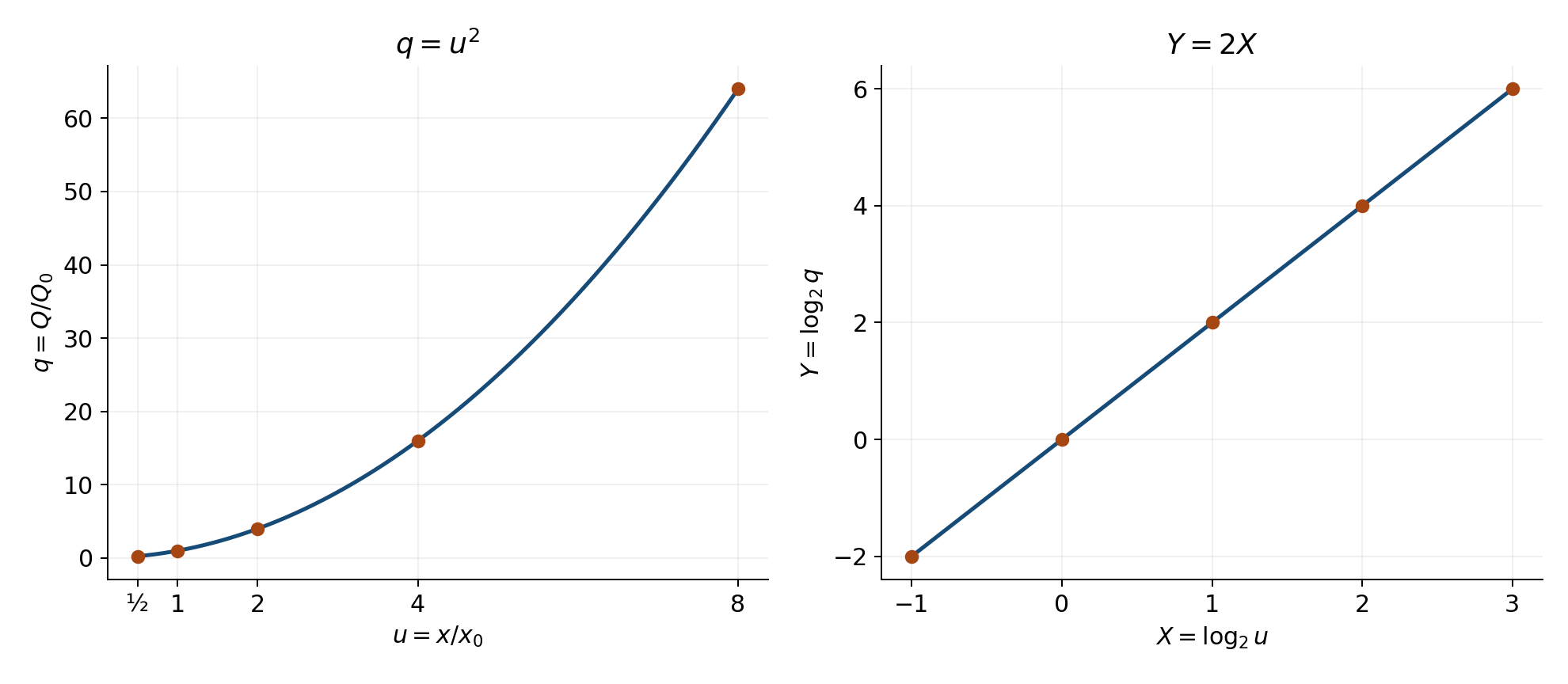
- Transform all five pairs and use two points on the right graph to find its slope. Under the assumed power-law model , determine and recover the equation in ordinary ratio coordinates.
- Explain what one horizontal unit on the right plot means for the original input. If an input is tripled within the model's validity range, by what factor does its output change?
- Why can neither a zero nor a negative input/output ratio be placed on the logarithmic plot? Do negative values of or represent negative physical ratios?
- Do five collinear transformed points prove that the power law holds at every positive input, or that the ordinary-coordinate graph is a straight line? Distinguish graphical evidence, an assumed model and a universal conclusion.
Solution · Graphical problem G4
-
The transformed pairs are
For instance the slope through and is . If with , taking base-two logarithms gives . The power-law model therefore requires , so . Substitution checks all five original pairs. In physical variables this candidate is , or . The references retain the model's units; logarithms were taken of ratios, not dimensioned concentrations or times.
-
Increasing by one multiplies by two, because . Equal horizontal distances on the transformed graph correspond to equal multiplicative factors, not equal additive increases in the original input. With exponent two, replacing by gives , so the output is multiplied by nine. If this is an empirical candidate model, both the original and tripled input must remain within whatever validity range is actually established.
-
Real logarithms require positive arguments, so , and negative ratios have no plotted logarithmic coordinates. In contrast, means , and means . A negative logarithmic coordinate indicates a positive ratio below one, not a negative physical quantity. The apparent intercept corresponds to , not to a zero input or zero output.
-
All five readings are consistent with this power-law hypothesis, and the given formula proves the line for every positive input within that mathematical model. The finite dataset alone cannot establish a physical law between or beyond its readings. Other functions can agree at all five inputs and differ elsewhere. Furthermore, a straight line in transformed coordinates is not a straight line in the original coordinates: has changing secant slopes there. Graphical appearance depends on the stated axes and scale. Extrapolating the model beyond the displayed interval needs independent scientific justification.
Summary
Integer powers are repeated multiplication and reciprocals. Rational powers require root and sign conventions; arbitrary real-exponent laws are safe with positive bases. Real logarithms require a positive base different from one and a positive argument. Their laws follow from exponentiation and inversion. The base determines whether a logarithmic inequality preserves or reverses order. Domains survive transformations, and exponential substitutions carry positivity restrictions. Logarithms turn a geometric error inequality into an integer threshold, but strict tolerances and rounding still need attention. Dimensionless ratios make logarithmic scientific models interpretable across units.
Connections. This chapter completes the exponentiation/logarithm algebra beyond Chapter 1's introductory inverse models. Chapter 5 supplies finite products and repeated changes; Chapter 6 supplies geometric remainders; Chapter 7 supplies sign-aware proof habits. Complex powers in Chapter 8 use a different number system and do not silently extend every real power convention here.